


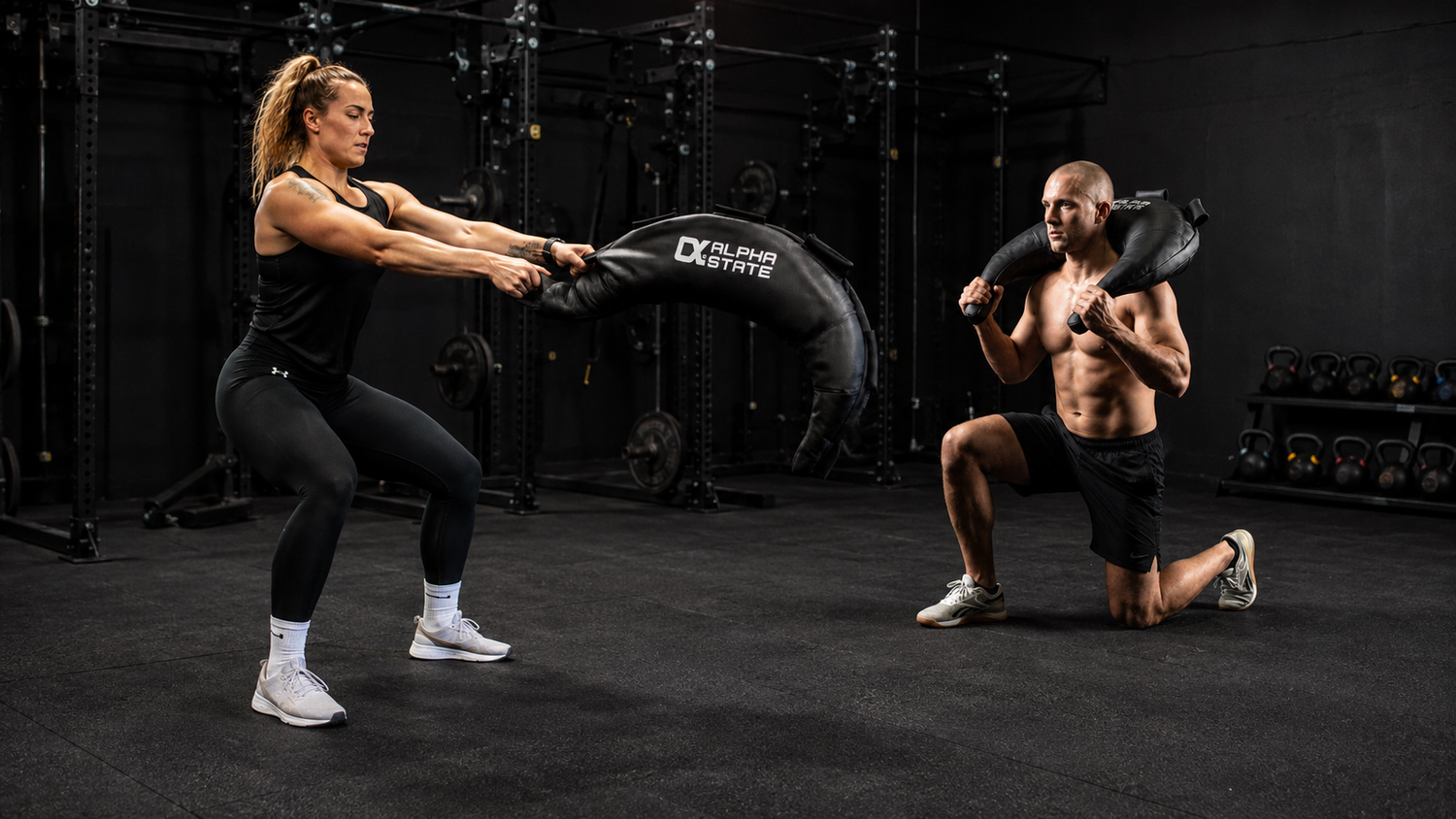
If you’re familiar with power bags, a Bulgarian bag will look like a close relative — roughly speaking, a croissant-shaped version with extra handles.
Both are soft, weighted training bags, and there is plenty of overlap in how they can be used. The main difference is the shape and how it encourages the load to move.
What do Bulgarian bags and power bags have in common?
Both can be used for full-body strength and conditioning. Depending on the weight and exercise, you can squat, lunge, press, pull, carry, clean or swing either type of bag.
They also work well in circuits because you can move between exercises without changing weights or setting up another station. Choose a lighter bag and work for longer, or increase the load for more strength-focused sets.
Neither belongs exclusively in the “strength” or “cardio” category. The way you programme the workout determines the training effect.
Why are power bags the go-to?
Power bags are popular for good reason. Their straight or cylindrical shape works naturally with familiar strength exercises such as deadlifts, cleans, squats, presses, rows and carries.
They can be held close to the body, lifted from the floor or carried across the shoulders. This makes them relatively straightforward to coach and easy to include in functional training circuits, group classes and athletic conditioning sessions.
In many ways, a power bag behaves like a softer, less rigid alternative to a barbell or pair of dumbbells. The load may shift slightly as you move, adding an extra stability challenge without completely changing the exercise.
AlphaState's range of multi-grip power bags are fantastic quality, and adhere to Hyrox specifications - note, they are sold empty.
What does a Bulgarian bag do differently?
The crescent shape changes the path of the load.
A Bulgarian bag can sit across the shoulders like a power bag, but its curved body and end handles also allow it to travel around the body more easily. This makes swings, spins, direction changes and rotational drills feel more natural.
Rather than every repetition having a clear start and finish, Bulgarian bag exercises can be linked into longer, flowing sequences. The athlete has to accelerate the bag, control its path and then slow or redirect it without losing position.
Changing between the different handles also places more demand on the hands and forearms, particularly during longer sets.
How does the conditioning feel different?
Power bag conditioning often follows the structure of a conventional strength circuit: complete a set of squats, move into presses, add a carry and then repeat.
A Bulgarian bag can be programmed in exactly the same way, but it lends itself particularly well to continuous, momentum-driven work. Spins, swings and other circular movements can be repeated or combined without putting the bag down.
This places more emphasis on grip endurance, timing, coordination and controlling the load as it changes direction. The bag does not necessarily need to be very heavy to create a demanding conditioning session.
That doesn’t make Bulgarian bag training automatically harder or better. Intensity still depends on the weight, exercise selection, pace and rest periods. It simply creates a different type of challenge.
Which bag should you use?
Choose a power bag when the focus is on familiar compound exercises, general strength endurance or an accessible group-training circuit.
Choose a Bulgarian bag when you want to introduce more rotation, momentum, grip work and multidirectional movement.
For many gyms, it isn’t an either-or decision. Power bags remain an extremely versatile training staple, while Bulgarian bags offer another way to challenge athletes who are ready for something different.
The AlphaState Bulgarian Bag Set includes 5kg, 10kg, 15kg and 20kg options, allowing the load to be matched to the exercise and the athlete’s experience (bags are also sold separately). All bags are already filled.
In short, a Bulgarian bag is not as a replacement for a power bag, kettlebell or barbell. It is a related training tool with its own movement style and rhythm.